You walked through a Beaune market at 8 a.m. and stopped at a counter selling steaming bowls of something that smelled of wine and thyme. Or maybe it was a small restaurant in Gevrey-Chambertin where the boeuf bourguignon arrived without ceremony, just a deep, glossy bowl of something profoundly satisfying. Whatever that moment was, Burgundy got to you through food. Now you’re home, and the hunger for it hasn’t quite gone away.
Your Burgundy Kitchen Passport
Burgundy’s most beloved dishes share a common thread: patience, good wine, and honest technique. Boeuf bourguignon, coq au vin, and Dijon-mustard preparations can all be made at home with the right approach. This guide walks through each one so you can cook your way back to the region, plate by plate.
Why Burgundian Food Stays With You Long After the Trip
Burgundy’s food culture doesn’t perform. It doesn’t need to. The region has been producing exceptional wine and cooking with it for centuries. The result is a cuisine that feels grounded. Humble, even. But every bite carries enormous depth.
The techniques that define Burgundian cooking, long braising, slow reduction, and cooking with wine in generous quantities, are all designed to coax out flavor over time. This is not food that hurries. It rewards anyone patient enough to let the process run its course.
Burgundy Today first opened many readers’ eyes to just how central food is to life in this part of France. Markets, wine caves, bistros that haven’t updated their menus in twenty years. All of it tells the same story: Burgundy eats seriously and eats well.
Setting Up Your Kitchen for Burgundian Cooking
French cooking from this region doesn’t demand professional equipment. What it demands is the right kind of heavy pot. A cast-iron Dutch oven or cocotte is the single most useful piece of kit you can own for this style of cooking. It holds heat evenly and moves from stovetop to oven without complaint.
Sharp knives matter more than most people realize. Precise cuts affect how evenly your ingredients cook and how long your prep takes. A well-maintained chef’s knife will improve your results significantly.
Here is what your pantry should include before attempting any of these dishes:
- A bottle of Pinot Noir or Bourgogne Rouge, the same quality you’d pour in a glass
- Good quality beef or chicken stock, ideally homemade
- Real Dijon mustard, not the yellow variety
- Fresh thyme, bay leaves, and flat-leaf parsley
- Pearl onions or shallots
- Lardons or thick-cut streaky bacon
- Unsalted butter in real quantities
- Cremini or button mushrooms, and wild mushrooms if available
If you’re new to French technique, beginning with classic French cooking will give you the grounding you need before attempting the longer, more involved recipes. Understanding how to build a braise or finish a sauce makes the whole process far less daunting.
Boeuf Bourguignon: The One Dish Worth Three Hours of Your Day
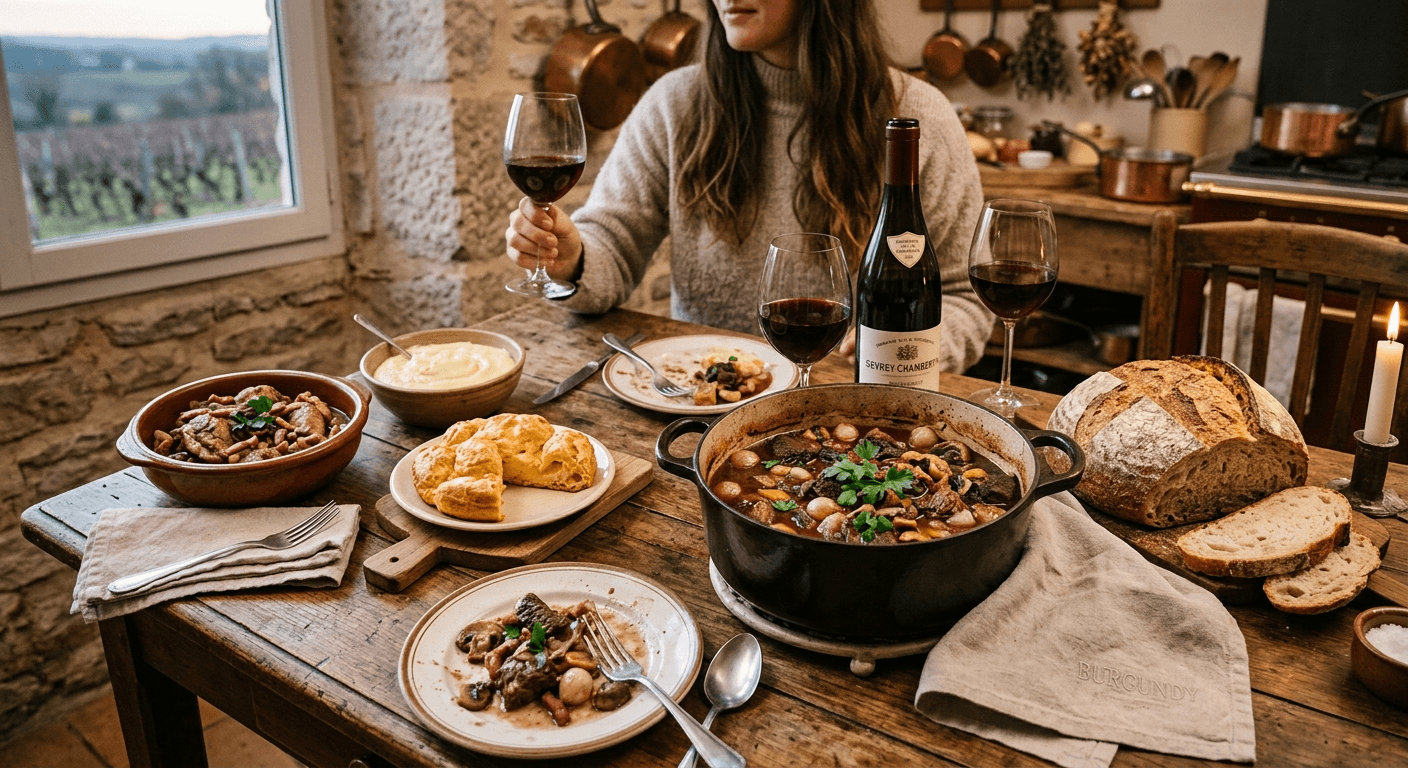
This is the flagship. No dish better represents Burgundy than boeuf bourguignon. It is essentially a beef stew, but calling it that doesn’t do it justice. The wine does things to the meat that water never could.
Here is how to do it properly:
- Choose marbled beef. Chuck or short rib is best. Lean cuts turn dry in a long braise. You want fat running through the meat.
- Brown in batches. Pat the meat dry, season with salt and pepper, and sear in batches in butter and oil over high heat. Crowding the pan causes steaming, not browning.
- Cook the lardons and pearl onions separately until they take on color. Remove and set aside.
- Deglaze the pan with cognac if you have it, scraping up all the fond. Then add the full bottle of wine and enough stock to just cover the meat.
- Add aromatics: garlic, tomato paste, bay leaves, and thyme. Bring to a gentle simmer.
- Braise in the oven at 160°C for three to four hours. The meat should pull apart easily when done.
- Add sautéed mushrooms in the final 20 minutes. Adjust seasoning and serve.
The dish is always better the following day. Make it on Saturday and serve it on Sunday. The flavors deepen overnight in a way that no amount of extra cooking time can replicate.
Coq au Vin: More Forgiving and Just as Satisfying
Coq au vin follows the same principles as boeuf bourguignon but uses chicken and requires less time. It’s a great dish if you want the full experience of Burgundian braising without committing an entire afternoon.
Use bone-in, skin-on pieces. Thighs and drumsticks stay moist throughout the cooking process. Breast pieces can dry out, so add them later in the braise if you use them.
- Optional but recommended: marinate the chicken overnight in red wine with sliced onion, carrot, garlic, and fresh herbs.
- Dry the chicken well before cooking. Wet meat doesn’t brown properly.
- Sear the pieces skin-side down in a hot Dutch oven until deeply golden. Set aside.
- In the same pan, cook lardons until crispy. Add pearl onions and mushrooms.
- Deglaze with wine and stock. Return the chicken to the pan.
- Simmer covered on low heat or in the oven at 160°C for 90 minutes.
- If the sauce needs thickening, whisk a small amount of softened butter into flour and stir it in during the final ten minutes.
Serve with egg noodles, mashed potatoes, or crusty bread to catch the sauce. A dressed green salad keeps the meal balanced without competing with the main dish.
What Dijon Mustard Does in the Pan
Dijon isn’t just for sandwiches. In Burgundian cooking, it acts as a binder, a flavor amplifier, and a sauce base all at once. Poulet à la moutarde is the clearest example of this technique in action.
The method is straightforward:
- Coat chicken pieces generously in Dijon mustard before searing. The mustard forms a crust that adds depth.
- Sear until golden and set aside.
- In the same pan, soften shallots in butter. Add white wine and let it reduce by half.
- Stir in crème fraîche and another generous spoonful of Dijon.
- Return the chicken and cook gently for 25 minutes, turning once.
- Finish with a handful of fresh tarragon.
This dish takes under an hour from start to finish. The mustard cuts through the cream and keeps the sauce from feeling heavy. It’s become a weeknight staple for anyone who spent time in Burgundy and came home wanting to cook differently.
A Look at Burgundy’s Most Iconic Dishes Side by Side
Cooking Times and Difficulty at a Glance
| Dish | Main Protein | Cooking Time | Difficulty |
|---|---|---|---|
| Boeuf Bourguignon | Beef (chuck or short rib) | 3 to 4 hours | Medium |
| Coq au Vin | Chicken (bone-in pieces) | 1.5 to 2 hours | Easy to Medium |
| Poulet à la Moutarde | Chicken | Under 1 hour | Easy |
| Soupe à l’Oignon | Vegetarian with cheese topping | 1.5 hours | Easy |
| Potée Bourguignonne | Pork (various cuts) | 2 to 3 hours | Medium |
The Broth-Based Side of Burgundy
Not every Burgundian dish is a long braise. The region also holds a strong tradition of soups built on wine-infused broths. These dishes are warming and filling, shaped by the same slow-cooked philosophy that defines the more famous stews.
Soupe à l’oignon is the most iconic. Caramelizing the onions properly takes at least 45 minutes of patient stirring. You cannot rush the process. The onions need to go from sharp and pungent to sweet and deeply golden. Everything that follows depends on that base.
Once the onions are ready, you add wine, good stock, and a splash of cognac. The soup is then ladled into individual crocks, topped with a thick slice of stale baguette and a mountain of Gruyère, then placed under a grill until the cheese bubbles and browns. It is one of the most satisfying things you can make in a home kitchen.
Burgundy also has potée, a farmhouse dish of pork belly, smoked sausage, and root vegetables cooked together in a seasoned broth. It’s not glamorous. It is deeply regional. For anyone who wants to build a fuller picture of this style of cooking, hearty French soups offer a broad collection to work through at home, from classic onion soup to rustic broth-based preparations that use wine exactly the way Burgundians have for generations.
Why Wine in the Pot Is Non-Negotiable
Home cooks often hesitate to pour a whole bottle of wine into a stew. It feels extravagant. But this is where Burgundian cooking diverges from most other traditions, and where the flavor difference becomes impossible to ignore.
Wine adds acidity that cuts fat, tannins that give structure to a sauce, and a fruity depth that no other liquid can replicate. As the alcohol burns off during cooking, what remains is a concentrated complexity that takes hours to develop naturally.
The rule is simple. Cook with wine you would be happy drinking. A decent supermarket Bourgogne Rouge or Pinot Noir works well for beef dishes. For chicken, a light white Burgundy or Chablis fits beautifully in coq au vin blanc, a lesser-known variation worth adding to your rotation.
Matching Your Cooking to the Season
Burgundy’s cuisine is shaped as much by its seasons as by its wine. Autumn brings wild mushrooms that transform a bourguignon into something extraordinary. Winter calls for the deepest braises and the most fortifying broths. Spring shifts toward lighter preparations with fresh herbs and young vegetables.
At home, the same principle applies. A boeuf bourguignon made in October with market mushrooms tastes different from one made in April with whatever’s left at the back of the fridge. Cooking with what’s in season doesn’t just improve flavor. It keeps the food honest, which is exactly what Burgundian cooking has always been.
The Kitchen Is Where the Trip Keeps Going
Food memories from travel carry a particular kind of weight. They hold the light in a dining room, the people across the table, the glass of wine that arrived without being asked for. No recipe can recreate all of that. But the cooking can get you surprisingly close.
Each time you brown beef in butter or let onions caramelize for a full hour, you’re not simply making dinner. You’re practicing a way of cooking that people in Burgundy have been returning to for centuries. You’re aligning your kitchen with a tradition that values time, good ingredients, and the patience to let both do their work.
That’s what makes this style of cooking worth returning to. Not just because the food is good, which it is. But because the process itself connects you to something real. The trip may be over. The cooking never has to stop.